
Brushes Beneath the Channel: The Hidden Role Widdop de Courcy Played in One of Britain’s Greatest Engineering Achievements
When passengers travel through the Channel Tunnel today, few realise they are passing through one of the most remarkable engineering projects of the 20th century – or that a small but important component manufactured by Widdop de Courcy helped make it possible.
Back in the 1980s, Widdop de Courcy supplied specialist industrial brushes that were fitted to the tunnel boring machines (TBMs) used during the construction of the Channel Tunnel, the ambitious project that finally linked Britain and mainland Europe by rail beneath the English Channel
.
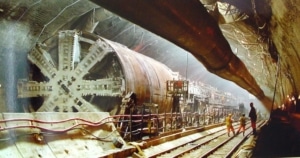
Construction of the tunnel began in 1988, with eleven enormous tunnel boring machines undertaking the task. Six machines started from the British side at Shakespeare Cliff near Dover, while five began from Sangatte in northern France. Each machine weighed approximately 1,000 tonnes and was purpose-built to excavate through the challenging chalk marl geology beneath the seabed.
Together, these engineering giants carved three parallel tunnels stretching for around 50 kilometres: two 7.6-metre diameter rail tunnels and a central 4.8-metre service tunnel. The precision achieved during excavation remains astonishing today. On 30 October 1990, the service tunnel breakthrough took place when British and French tunnelling teams met deep beneath the Channel. After kilometres of excavation from opposite directions, the final alignment differed by only a matter of centimetres.
Throughout the tunnelling process, every component of the TBMs had to perform reliably in an exceptionally harsh environment. Industrial brushes played an important role in maintaining electrical systems and machine operation, helping ensure the continuous performance required for one of the world’s most demanding tunnelling projects. Widdop de Courcy was proud to contribute to this achievement through the manufacture of specialist brushes supplied for use on these iconic machines.
Once the excavation was complete, engineers faced an unusual challenge: what to do with the tunnel boring machines themselves.
As the machines advanced, crews installed precast concrete lining rings behind them to form the finished tunnel structure. These rings reduced the internal diameter of the tunnel, making it impossible to simply reverse the TBMs out of the completed bores. Recovering the machines would have required costly and complex engineering works, and most were considered effectively single-use assets, designed specifically for the geology and alignment of the Channel Tunnel.
The French and British teams adopted different solutions. At Sangatte, the French machines were dismantled and lifted back to the surface through existing access shafts. On the British side, however, recovery was far less practical. Engineers redirected several of the marine TBMs away from the tunnel alignment and drove them down into the chalk beneath the tunnel. Valuable reusable components were removed, while the remaining structures were sealed underground.
In one of the more remarkable details of the project, Channel Tunnel documentation records that the buried machines were subsequently connected into the tunnel’s electrical grounding system, with their steel structures serving as part of the earth return network.
Not every machine disappeared from view. One French TBM, known as T4 “Virginie”, has its cutterhead preserved as a monument near Coquelles, while another British machine stood beside the M20 near Folkestone for many years before being sold at auction in 2004.
More than three decades later, trains continue to travel through the three tunnels every day, carrying millions of passengers and tonnes of freight between Britain and Europe. Hidden beneath the chalk are several of the original machines that made the crossing possible – silent reminders of a project that changed transport history.
For Widdop de Courcy, the Channel Tunnel represents more than a landmark engineering achievement. It stands as a proud chapter in our own history, demonstrating how British manufacturing expertise and reliable industrial components contributed to one of the world’s most ambitious infrastructure projects. While our brushes may have been only one part of these extraordinary machines, they played their role in helping create a permanent link between nations – a legacy that continues to serve generations today.
Back to all posts